1 / 11
Real discussions from product enthusiasts
100% Cotton vs. Blends: Breathability and Feel
While cotton blends might offer easier care or wrinkle resistance, 100% cotton like the Market Place Quilt excels in natural breathability. Cotton fibers wick moisture effectively and allow airflow, contributing to comfort across a wider temperature range, though they may require more careful washing to prevent shrinkage.
Hand-Quilting: Aesthetic vs. Machine Stitching Uniformity
Hand-quilting, as seen in the Market Place Quilt, adds unique texture and artisanal value, often resulting in slightly varied stitch depths. Machine-stitching, conversely, provides uniform tension and speed, which can enhance durability through consistent thread engagement and fewer potential weak points.
California King vs. Standard King Dimensions
The California King (103"x103") is typically longer and narrower than a standard King (108"x98"). This specific sizing ensures a proper drape on longer, narrower mattresses, preventing excess fabric pooling at the foot or sides, crucial for maintaining the intended aesthetic of a bedspread.
Ticking Fabric: Durability and Design
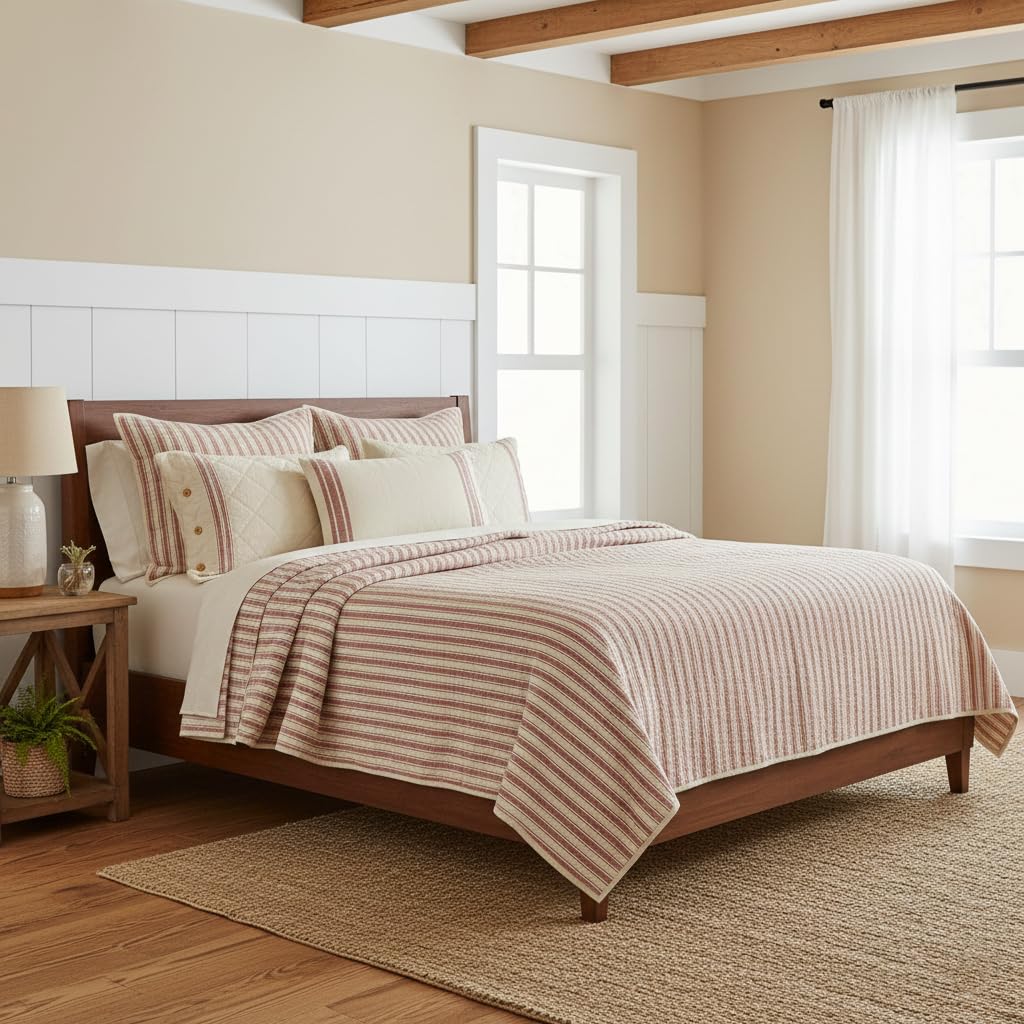
Ticking fabric, characterized by its woven stripes and dense weave, historically served to contain feathers. In modern bedding like the Market Place Quilt, it offers a durable surface with a distinct visual appeal, contributing to the rustic farmhouse aesthetic while providing a robust base for quilting.
Expert answers based on real user experience
The dual construction method employed in the Market Place Quilt aims to leverage the strengths of both hand-quilting and machine-stitching. Hand-quilting, often characterized by its unique stitch density and artistry, provides decorative appeal and allows for intricate patterns. Machine-stitching, typically with finer thread counts (e.g., 200-300 TPI on modern machines), ensures consistent tension and secures layers efficiently, preventing shifting over time. This combination, when executed with solid cotton threads and tight stitch spacing (e.g., 5-7 stitches per inch), can enhance the quilt's resilience against daily wear and wash cycles, reducing the risk of seam separation or batting clumping, which are common failure points in lesser-constructed bedding.
Piper Classics
Get notified when the price drops
Piper Classics Market Place Red California King Quilt, 100% Cotton Quilted Bedspread with Red Ticking, Hand Quilted Grain Sack Bed Spread Bedding for Boho, Shabby Chic and Rustic Farmhouse Decor (103”x103”). Features: 100% Cotton. ENHANCE YOUR RUSTIC DECOR with quaint grain sack farmhouse bedding and access.... 103” x 103” CALIFORNIA KING QUILT features a 100% cotton shell and batting. T.... DURABLY CONSTRUCTED with hand-quilting and machine-stitching, the Piper Class.... 100% COTTON MATERIAL...

Piper Classics
Piper Classics Katie's Vintage Stripe Twin Coverlet Bedspread, 90" x 70", Urban Rustic Farmhouse Bedding, Natural Cream w/Black Stripes Blanket
 -99%
-99%Petsology
Flea and Tick Prevention for Dogs Pills - Natural Dog Flea & Tick Control - 170 Soft Chewables - Oral Defense Treatment for Dogs Supplement - Vet Formulated Chews - All Breeds & Ages - Made in USA
 -99%
-99%RICE KRISPIES TREATS
Rice Krispies Treats Marshmallow Snack Bars, Kids Snacks, School Lunch, Rainbow (12 Boxes, 96 Bars)
 -96%
-96%Amerdeco
Amerdeco 10 Pack Champagne Bronze Cabinet Pulls 5 Inch(128mm) Hole Center Drawer Pulls Cabinet Hardware Kitchen Cabinet Handles for Bathroom ZH0075
For the Market Place Quilt, maintaining its 100% cotton integrity and the vibrancy of its red ticking requires specific care. Washing in cold water on a gentle cycle is recommended to minimize fiber stress and prevent dye migration, especially for the red stripes which can be prone to bleeding if exposed to hot water or harsh detergents. Using a mild, bleach-free detergent is crucial; some users suggest a detergent with a pH between 6.0 and 7.5 for optimal fabric preservation. Tumble drying on a low heat setting or air drying is preferable to high heat, which can cause shrinkage (typically 1-3% for cotton) and damage delicate fibers. Ironing, if necessary, should be done on a medium setting.
The Market Place Quilt's 100% cotton construction offers inherent breathability, making it adaptable for various comfort levels. Cotton fibers are naturally hollow, allowing air to circulate freely, which helps regulate body temperature by wicking away moisture. In warmer conditions, this breathability prevents overheating. In cooler temperatures, the cotton batting traps air, providing insulation. While not as insulating as specialized synthetic fill or down, a well-quilted cotton bedspread like this can provide substantial warmth, suitable for use in environments ranging from mild autumn evenings (e.g., 15°C) to colder winter nights when layered with additional blankets. The natural fiber also offers a soft, tactile feel against the skin.
The woven cotton ticking fabric in the Market Place Quilt, designed for a rustic aesthetic, typically features a moderately tight weave. While cotton offers good tensile strength, its abrasion resistance varies with yarn quality and weave density. For a standard ticking weave, expect a Martindale abrasion rating in the range of 10,000-20,000 cycles, which is generally considered suitable for moderate upholstery and bedding use. However, continuous friction, such as from pets or frequent repositioning of the quilt without protective measures, could lead to pilling or thinning of fibers in high-wear areas over time, potentially affecting its visual integrity after several years of consistent daily exposure.
The hand-quilted grain sack design, while aesthetically pleasing, can introduce variations in stress distribution across the quilt's layers. Hand-quilting stitches, though often tied at intervals, can create localized tension points. If these points are significantly tighter than surrounding areas or if the thread used is of a different tensile strength than the base fabric, it could potentially lead to differential wear. Over time, repeated flexing or pressure on these specific stitch points might cause the fabric to fatigue or fray slightly faster than areas with a more uniform, machine-controlled stitch pattern, which typically distributes load more evenly across a larger surface area.